Childcare deserts are family infrastructure gaps hiding in plain sight.
ChildcareDesert.com maps where young children significantly exceed available childcare capacity â helping families, employers, providers, policymakers, and communities understand where childcare access is most strained.
When licensed childcare supply cannot meet local family demand, the effects reach far beyond parents. Childcare deserts affect workforce participation, employer stability, school readiness, family income, transportation, neighborhood opportunity, and economic development.
Core Question: How many young children are competing for each available childcare slot in a ZIP code, city, county, or district?
ZIPLocal childcare access
SlotsLicensed capacity
0-5Young-child demand
MapChildcare desert severity
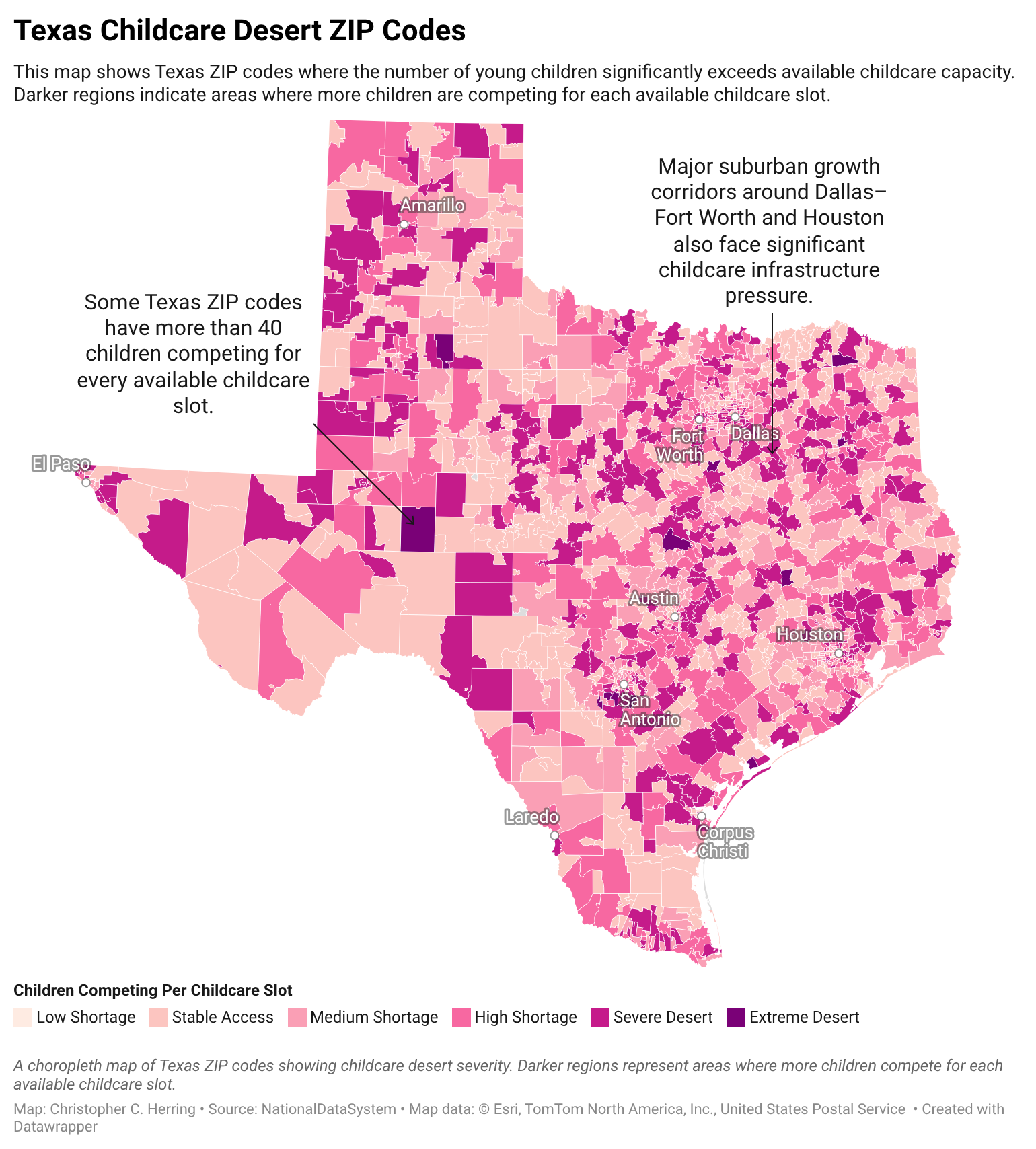
Texas Childcare Desert ZIP Code Map
This example map shows Texas ZIP codes where the number of young children significantly exceeds available childcare capacity. Darker regions indicate areas where more children are competing for each available childcare slot.
ZIP-Level Pressure
Identify where childcare shortages are concentrated instead of relying on broad statewide averages.
Family Demand
Compare young-child population against licensed childcare capacity.
Access Gaps
Reveal communities where families may face limited options, long waitlists, or informal care pressure.
Policy Targeting
Support grantmaking, provider expansion, workforce planning, and local investment decisions.
What childcare deserts mean for families.
Families often experience childcare deserts as stress, reduced work hours, long commutes, waitlists, affordability pressure, and difficult choices about employment and care.
Limited Availability
Families may struggle to find licensed childcare close to home, work, school, or transit routes.
Workforce Disruption
Parents may miss work, reduce hours, delay employment, or leave the workforce due to childcare gaps.
Transportation Burden
Families may travel farther to access care, increasing commute time and daily instability.
School Readiness
Limited early learning access can affect kindergarten readiness and long-term educational opportunity.
Childcare deserts affect employers and economic development.
Childcare access is a workforce infrastructure issue. Employers, chambers, workforce boards, and economic development leaders need to know where childcare shortages may be limiting labor force participation.
Employer Stability
Childcare shortages can affect attendance, hiring, retention, productivity, and shift coverage.
Workforce Planning
Childcare data helps identify where working families face access barriers.
Business Attraction
Communities with stronger childcare infrastructure may be better positioned for growth.
Local Investment
Childcare desert maps can guide provider expansion, grants, partnerships, and public-private solutions.
Childcare intelligence products.
ChildcareDesert.com can support families, employers, providers, chambers, school districts, cities, counties, nonprofits, foundations, workforce boards, and policymakers.
Childcare Desert ZIP Profiles
Profiles showing childcare access pressure, young-child demand, licensed slots, and shortage severity by ZIP code.
County Childcare Reports
County-level reports connecting childcare infrastructure to workforce, family stability, and economic opportunity.
Employer Childcare Briefings
Reports helping employers understand how childcare gaps may affect workers and retention.
Policy & Grant Support
Maps and data products for grant applications, legislative briefings, community planning, and provider expansion.
Provider Opportunity Analysis
Identify ZIP codes and communities where licensed childcare supply may not meet local demand.
Statewide Childcare Rankings
Rank ZIP codes, cities, counties, and districts by childcare desert severity and family infrastructure pressure.
Who uses childcare desert intelligence?
Families
Understand local childcare access conditions before choosing care, moving, or changing work schedules.
Providers
Identify communities where demand may support expansion, new locations, or new service models.
Employers
Evaluate childcare as a workforce stability, retention, and productivity issue.
Public Leaders
Use ZIP-level intelligence to target investments, policy, grants, and community partnerships.
Request a childcare desert report or submit local information.
Tell us about your ZIP code, city, county, employer, childcare center, or community concern. We can help turn childcare access questions into practical intelligence.